
Ekiti Approves Landmark Tourism Policy with 10-Year Master Plan to Drive Economic Growth, Global Recognition
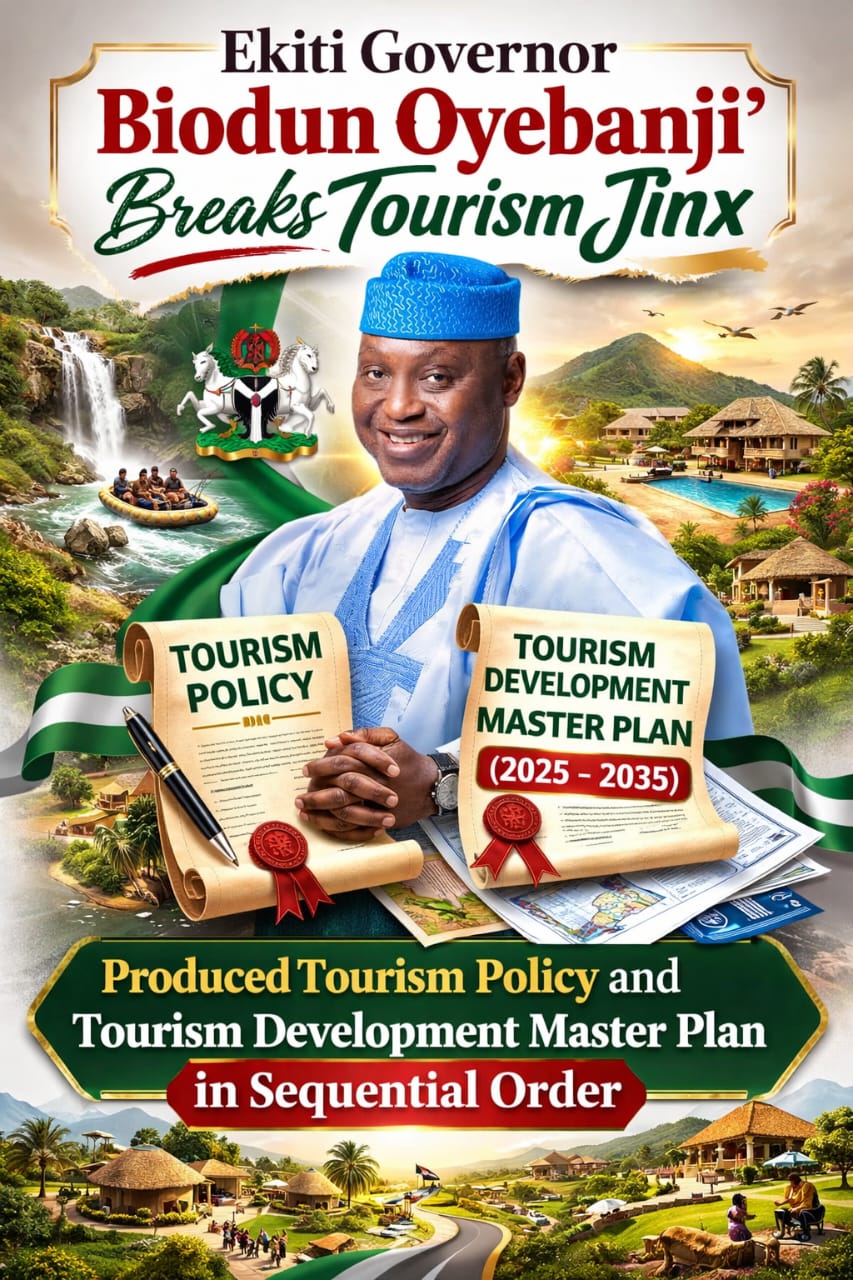
In what analysts have described as a watershed moment for sub-national tourism governance in Nigeria, the Ekiti State Executive Council has formally approved the implementation of a comprehensive Tourism Policy and a Tourism Development Master Plan (2025–2035) for Ekiti State, setting the stage for an ambitious transformation of the state’s tourism sector.
The twin approvals signal a strategic shift aimed at repositioning Ekiti as a premier heritage and nature-based destination within Nigeria, across West Africa, and in the global tourism marketplace. Observers say the initiative establishes a structured governance architecture that could serve as a template for tourism planning among other Nigerian states.
Governor Biodun Abayomi Oyebanji, whose administration championed the initiative, is being credited with breaking what industry stakeholders have long regarded as a “tourism governance jinx” by producing and securing executive endorsement for both a policy framework and a master plan in a deliberate sequence.
Analysts note that while tourism strategies have existed in parts of Nigeria, this is the first instance of a state government adopting a coordinated dual-document system designed to guide both policy direction and execution.
A distinctive feature of the policy’s development was the participation of United Nations Tourism, which provided technical guidance, international benchmarking, and professional advisory support.
Officials say this marks the first time the global tourism body has directly collaborated with a sub-national government on the conceptualisation of a tourism policy, lending international credibility and alignment with global standards.
The Tourism Development Master Plan, coordinated by the Ekiti State Bureau of Tourism Development, outlines a long-term roadmap for unlocking the state’s largely under-utilised tourism assets. These include waterfalls, warm springs, mountain landscapes, heritage corridors, historical relics, and eco-tourism sites.
Prepared by Red Clay Advisory Services, the plan proposes phased infrastructure expansion, investment mobilisation strategies, thematic tourism circuits, and visitor-experience enhancement systems. Officials say it also integrates sustainability principles, local enterprise development, job creation, and environmental stewardship into its implementation model.
Complementing the master plan is a governance-focused Tourism Policy developed with support from Overseas Credit & Private Equity Limited. The document provides regulatory clarity, institutional coordination mechanisms, and investment guidelines intended to ensure consistent, transparent, and sustainable sector growth.
The policy promotes multiple tourism niches – including eco-tourism, cultural tourism, adventure tourism, and business tourism – while outlining standards for safety, service delivery, infrastructure, and market development.
Officials explained that the policy will function as a strategic compass, defining direction and governance structures, while the master plan serves as the execution engine translating vision into measurable socio-economic outcomes.
Officials Hail ‘Structural Rebirth’
Reacting to the approval, Director-General of the Bureau, Wale Ojo-Lanre, described the decision as “a structural rebirth of tourism governance not only in Ekiti State but a reference point for sub-national tourism development across Nigeria,” adding that the move shifts the sector “from aspiration to execution.”
He disclosed that the next phase will focus on activating implementation mechanisms, mobilising stakeholders, attracting investors, and establishing delivery systems to ensure the plan’s objectives translate into tangible development.
Economic and Social Impact Goals
Authorities say the overarching objective of the twin frameworks is to harness Ekiti’s tourism potential to generate sustainable employment, stimulate small and medium-scale enterprises, attract domestic and international visitors, and deliver inclusive prosperity for host communities and investors alike.
With the approvals now secured, the state government has indicated that further announcements – including policy unveiling ceremonies, investment summits, and milestone updates – will be released in due course as Ekiti advances its bid for global recognition as a leading eco-cultural tourism destination.