
NAMA Activates Emergency Backup for Air Traffic Control as Fire Cripples Key Aviation Systems at Lagos Airport
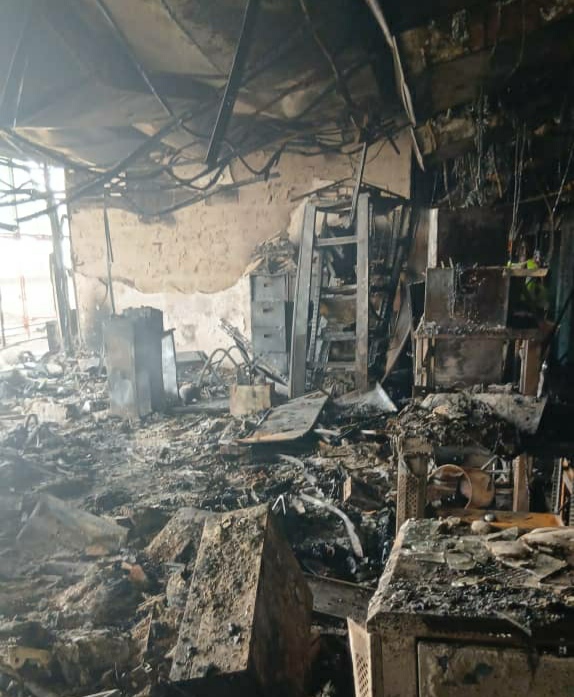
A devastating fire outbreak at the old terminal complex of Lagos’s main aviation hub has destroyed vital air-traffic communication infrastructure, prompting emergency contingency measures and a temporary suspension of inbound flights, according to the Nigerian Airspace Management Agency.
Managing Director Ahmed Umar Faroukh confirmed that the blaze, which erupted on 23 February 2026, inflicted severe damage on air-to-ground communication systems and disrupted multiple air-navigation services critical to flight coordination.
Speaking during an inspection of the affected site in Lagos, Faroukh explained that the incident occurred while senior management officials were in a meeting, forcing an immediate emergency response.
“What we saw actually was a huge loss as far as communication is concerned and other air traffic services were really disrupted. So we had no option at that time than to suspend inbound aircraft into Lagos,” he said.
Swift Response Amid Chaos
Faroukh said he immediately dispatched the agency’s Director of Operations and engineering teams to assess the damage and stabilise affected systems. He commended technical personnel who remained at their duty posts despite the risks posed by the inferno, noting that several staff members prioritised operational continuity over personal safety.
According to him, emergency backup communication systems sourced from other locations have now been installed, restoring essential services and allowing flight operations to continue while permanent repairs are planned.
Although primary communication facilities suffered extensive destruction, the NAMA chief reassured passengers and airlines that national airspace remains secure. “I want to assure Nigerians and the flying public that air-to-ground communication will remain uninterrupted,” he stated.
Authorities initially faced difficulty deploying a mobile control tower because the terrain required civil engineering stabilisation before equipment could be mounted. A foreign contractor working at the site later prepared the ground, enabling installation of the temporary structure within roughly 24 hours.
Faroukh noted that the full financial cost of the damage is still unknown, as technical teams continue detailed evaluations of affected installations. “It will be very difficult for me to tell you the magnitude of the loss. It will take us a while,” he added.
Aviation analysts observe that communication and navigation systems rank among the most expensive airport assets, often costing millions of dollars to procure and install, especially radar, radio transmitters, and approach-control equipment essential for aircraft guidance.
The incident is the latest reminder of infrastructure vulnerabilities confronting airports across parts of Africa, where ageing facilities, fluctuating power supply, and heavy operational loads can strain reliability.
The Federal Airports Authority of Nigeria has been working alongside NAMA to maintain operational continuity and ensure compliance with safety standards.
Nigeria’s Aviation and Aerospace Development Minister, Festus Keyamo, has repeatedly stressed that emergency contingency mechanisms – including redundant communication links and mobile towers – form part of national aviation resilience protocols aligned with global benchmarks set by the International Civil Aviation Organization.
Industry specialists emphasise that such redundancy is mandatory under international aviation regulations, ensuring aircraft can land safely even when primary systems fail.
Initial incident reports indicate the blaze engulfed sections of the old terminal complex and installations connected to control operations. Emergency responders, firefighters, and rescue teams were swiftly mobilised, and authorities confirmed that no fatalities were recorded – a development widely described by aviation stakeholders as a significant relief given the scale of destruction.
Engineers are expected to complete a comprehensive technical audit before reconstruction work resumes.
Until then, the NAMA boss insisted that temporary systems and backup technology are fully functional, guaranteeing safe flight operations across Nigeria’s busiest aviation gateway.