

Fidelity Bank’s PAPSS Boosts Cross-Border Trade for Nigerian Businesses
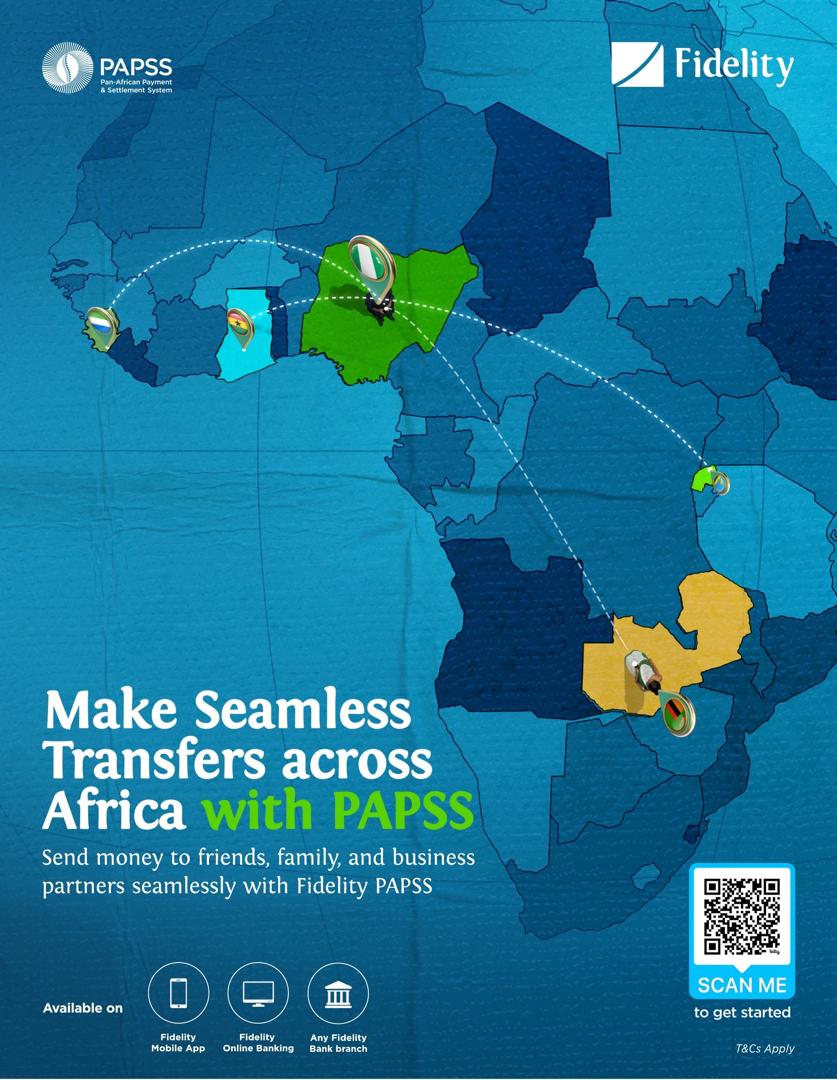
Fidelity Bank Plc has said its adoption of the Pan-African Payment and Settlement System (PAPSS) is helping Nigerian businesses simplify cross-border transactions and expand their commercial activities across African markets.
The bank said the payment platform was increasingly becoming an important tool for businesses seeking to take advantage of opportunities created by the African Continental Free Trade Area (AfCFTA), particularly by easing the process of paying suppliers and receiving proceeds from eligible transactions within Africa.
According to Fidelity Bank, Nigerian businesses are increasingly looking beyond the domestic market for suppliers, customers and investment opportunities, with companies sourcing goods and services from countries such as Ghana, Kenya, Rwanda and Zambia.
It noted that while the expansion of intra-African trade presented significant opportunities for manufacturers, exporters, retailers, technology companies, farmers, commodity aggregators and small businesses, the ability to make and receive payments efficiently remained critical to successful regional trade.
The bank explained that conventional cross-border payment channels could expose businesses to several challenges, including the need to source foreign currencies, multiple currency conversions, intermediary banks, additional transaction costs and lengthy processing times.
It said such challenges could affect business cash flow, delay supplies and make it more difficult for Nigerian companies to establish and maintain commercial relationships in other African countries.
PAPSS, according to the bank, is designed to address some of these challenges by providing a payment infrastructure for secure, efficient and near-instant transactions between participating African countries.
Under the system, an eligible Nigerian customer can initiate a transaction in naira, while the beneficiary receives the equivalent value in the applicable local currency.
Fidelity Bank said the arrangement could reduce the need for businesses to obtain United States dollars or euros before settling eligible transactions within Africa.
It added that the system could also reduce unnecessary currency conversions and dependence on correspondent banks outside the continent, potentially resulting in simpler payment processes, faster settlement and greater visibility of transaction costs.
The bank said speed was another major advantage of the platform, noting that PAPSS transfers conducted through Fidelity Bank could be completed in about 120 seconds, subject to applicable requirements and the receiving market.
It said the faster settlement could be particularly valuable to businesses dealing with time-sensitive supplies and invoices.
“For a manufacturer waiting for raw materials, faster settlement can help ensure that an eligible invoice is paid promptly and supplies are delivered according to agreed schedules,” the bank said.
Similarly, retailers importing products from other African countries could reduce some of the difficulties associated with obtaining foreign currency, while exporters could receive eligible payments in naira for goods sold across Africa, subject to applicable regulatory and export requirements.
Beyond commercial transactions, Fidelity Bank said PAPSS could also support other eligible payments, including school-related payments by parents and guardians, family support and other permitted personal transactions across supported African corridors.
The bank, however, stressed that customers must meet applicable regulatory, compliance and documentation requirements when using the platform.
It said beneficiary details, the purpose of the transaction and supporting documents must be complete and accurate before a payment is initiated.
Fidelity Bank also highlighted the importance of choosing a financial institution with the necessary infrastructure and experience to facilitate cross-border payments.
The bank said its combination of digital banking platforms, nationwide branch network and experience supporting small and medium-sized enterprises, exporters and other businesses placed it in a strong position to provide access to PAPSS.
Customers can initiate eligible PAPSS transfers through the Fidelity Mobile App and Fidelity Online Banking, while customers who require assistance can access the service through Fidelity Bank branches or Relationship Managers.
The bank said its experience with PAPSS dates back to September 2024, when it onboarded the payment platform.
According to Fidelity Bank, it recorded more than N46 billion in PAPSS transactions during the early adoption phase before the platform’s official launch in August 2025.
It added that PAPSS had identified Fidelity Bank as one of the first Nigerian banks to meet the relevant integration requirements.
The bank said the experience had provided it with a strong foundation to support customers seeking to conduct eligible cross-border transactions within Africa.
Fidelity Bank has subsequently expanded access to PAPSS through its digital channels and branch network, allowing customers to choose between self-service and assisted banking options.
The bank said digital access through the Fidelity Mobile App and Fidelity Online Banking provided convenience for customers, while branch-based support remained available to individuals and businesses that required assistance with documentation, compliance requirements or transaction procedures.
Security, it added, remained an important component of the PAPSS framework, with transactions authenticated and processed through formal banking channels and subjected to applicable validation, compliance and regulatory checks.
The bank said the growth of PAPSS reflected the changing nature of African commerce, where businesses were increasingly using digital platforms to identify suppliers, reach customers and coordinate transactions across national borders.
According to data cited by Fidelity Bank from TechCabal, PAPSS is currently live in 19 countries and connects more than 160 commercial banks and over 15 national payment switches.
The expansion of the payment network, the bank said, was creating the infrastructure needed to support increased intra-African trade by making it easier for businesses to move money across participating markets.
For Nigerian businesses, Fidelity Bank said the development could have implications beyond payment convenience, as faster and more predictable settlements could improve cash-flow management, strengthen relationships with suppliers and support operational planning.
Businesses engaged in regional trade could also benefit from reduced exposure to unnecessary currency conversions and the challenges associated with sourcing international currencies for eligible African transactions.
Fidelity Bank said its early participation in PAPSS, transaction experience, digital platforms and physical branch network had positioned it to serve businesses seeking to take advantage of the growing African trade market.
The bank maintained that as the implementation of AfCFTA continues to encourage businesses to explore markets beyond their home countries, efficient payment infrastructure would become increasingly important to the success of regional commerce.
It said businesses capable of moving funds efficiently would be better placed to secure supplies, maintain commercial relationships, serve customers in new markets and take advantage of emerging opportunities across the continent.
Through Fidelity Bank PAPSS, eligible customers can send money in naira to selected African countries, with beneficiaries receiving the applicable value in their respective local currencies.
The bank said transactions remained subject to supported corridors, applicable limits, charges, regulations, terms and conditions.