
ABUAD Confers Honorary Doctorate on United Nigeria Airlines Chairman, Ooni, Oyebanji Praise Carrier
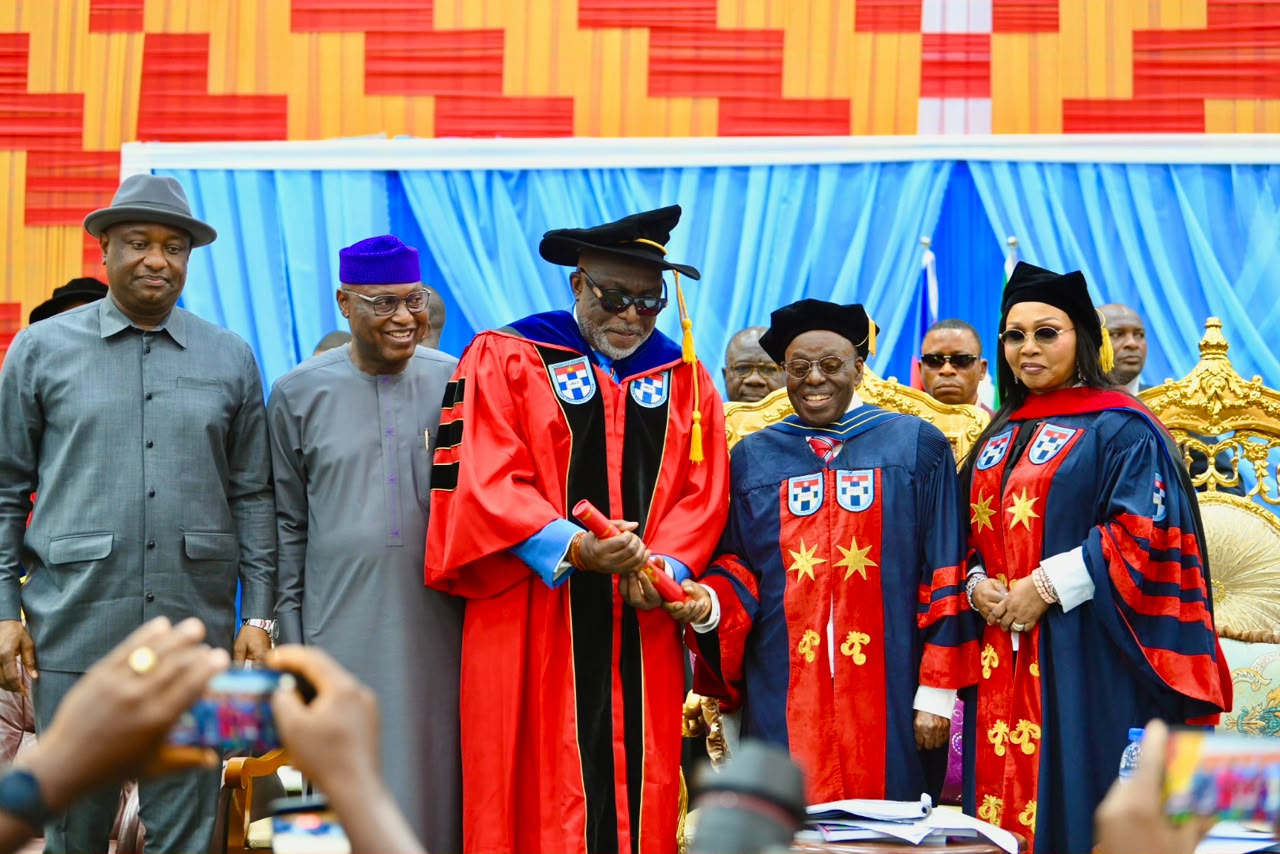
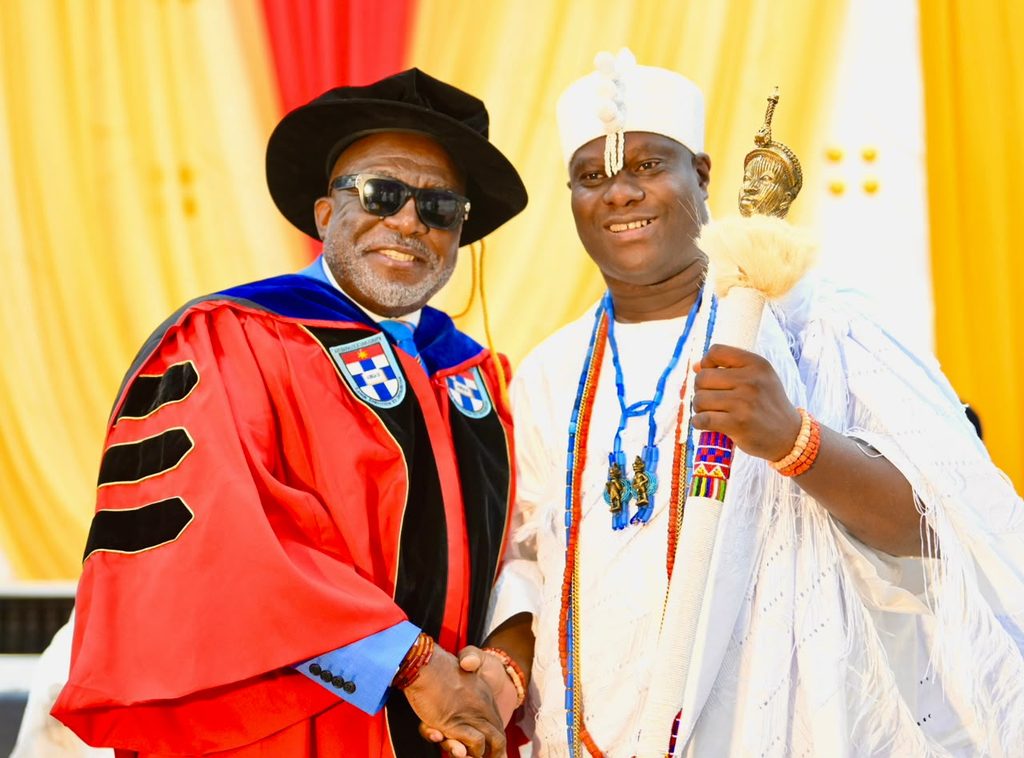
Afe Babalola University, Ado-Ekiti (ABUAD), has conferred an Honorary Doctor of Letters (D.Litt) degree on the Executive Chairman of United Nigeria Airlines, Prof. Obiora Okonkwo, as the Governor of Ekiti State, Abiodun Oyebanji, and the Ooni of Ife, Oba Adeyeye Enitan Ogunwusi, Ojaja II, commended the airline for sustaining flight operations to the state.
The honorary degree was conferred on Okonkwo during the university’s 14th convocation ceremony held on Wednesday in Ado-Ekiti, Ekiti State.
The recognition followed his delivery of the institution’s 14th convocation lecture, during which he advocated a comprehensive reform of Nigeria’s education system to prioritise practical skills, entrepreneurship, ethical values and human capital development.
The lecture, titled “Functional Education and the Nigerian Project: Strategic Human Capital Development for National Renewal,” was delivered on Tuesday at the university’s Alfa Begore Hall.
Meanwhile, Oyebanji and the Ooni commended United Nigeria Airlines for its contribution to improving air connectivity to Ekiti, particularly through its services linking the state with Lagos and Abuja.
The governor also acknowledged the airline’s corporate social responsibility initiatives, highlighting its donation of a primary healthcare centre and a solar-powered borehole to Aso-Ayegunle community.
Oyebanji disclosed that he had commissioned the facilities a day before the convocation ceremony, noting that the project had been handed over to the Ekiti State Ministry of Health and was already in use.
The intervention, according to the governor, demonstrated the importance of private-sector participation in community development and the provision of essential services.
The Ooni of Ife, on his part, praised the airline for maintaining its flight operations to Ekiti, observing that the services had made travelling to and from the state considerably easier.
He noted that United Nigeria Airlines was currently the only carrier operating flights to Ekiti from both Lagos and Abuja, making its operations particularly significant to the state’s accessibility.
The monarch’s commendation underscored the importance of reliable air services to residents, business travellers and visitors, as well as the potential contribution of improved connectivity to economic activities in the state.
Okonkwo’s honorary doctorate also brought attention to his advocacy for an education system that responds more directly to Nigeria’s economic and social needs.
In his convocation lecture, he argued that although functional education had featured repeatedly in government policies, university programmes and employers’ demands, the country had not sufficiently defined what it should achieve in practical terms.
He maintained that education should not be judged solely by academic qualifications but by its ability to equip graduates with relevant competencies, prepare them for employment, encourage entrepreneurship and enable them to contribute to national development.
According to him, Nigeria needs to move away from an education system that places excessive emphasis on theoretical knowledge towards one that combines classroom learning with practical experience, innovation and problem-solving.
He called for curricula that reflect the country’s economic priorities, technological advancement and labour market demands.
Okonkwo identified agriculture, engineering, medicine, business, law and the sciences as areas where universities should strengthen practical training, research and entrepreneurship programmes.
He argued that graduates should be equipped not only to secure employment but also to create businesses, generate jobs and develop solutions to problems confronting their communities.
The airline chairman also emphasised the importance of moral education, warning that technical competence and professional qualifications would not be sufficient to guarantee sustainable national development if ethical standards continued to deteriorate.
“Human capital without moral capital cannot sustain national development,” he said.
He identified integrity, discipline, patriotism, leadership, accountability, industry, compassion and humanity as values that tertiary institutions should deliberately promote.
Drawing on the works of Francis Fukuyama and Douglass North, Okonkwo linked public trust, ethical conduct and institutional quality to economic competitiveness.
He argued that investors were more likely to commit resources to environments where contracts were respected, institutions were dependable and accountability was upheld.
The lecture received strong commendation from ABUAD’s founder, Aare Afe Babalola, a Senior Advocate of Nigeria (SAN), who described it as one of the most brilliant lectures he had heard.
Babalola said the presentation offered ideas that could contribute to reforming Nigeria’s education sector and announced plans to forward a copy to the National Universities Commission (NUC), the Federal Ministry of Education and President Bola Tinubu for consideration.
He particularly welcomed the emphasis on curriculum reform, arguing that educational institutions must prepare students for the realities of the future rather than continue to rely on approaches that may no longer meet the country’s needs.
“We cannot teach here what we are going to become in the future without considering the curriculum,” Babalola said.
He also raised concerns about the proliferation of universities without what he considered adequate facilities and academic standards.
The ABUAD founder called for more rigorous scrutiny of institutions seeking approval to operate, recalling that NUC officials previously conducted physical inspections of facilities before granting approval.
He advocated greater attention to institutional preparedness, infrastructure and quality assurance to ensure that universities could provide the standard of education expected of them.
His pledge to submit Okonkwo’s lecture to key government institutions and the President positioned the presentation as a potential contribution to national policy discussions on education reform.
Former NUC Executive Secretary and Chairman of the Nigerian Universities Ranking Advisory Committee, Prof. Peter Okebukola, also praised the lecture, saying Okonkwo had covered the essential attributes of a functionally educated person.
Similarly, ABUAD Vice-Chancellor, Prof. Smaranda Olarinde, described the lecture as an important platform for intellectual engagement on issues affecting the university, Nigeria and humanity.
The recognition of Okonkwo comes against the backdrop of his leadership of United Nigeria Airlines and the carrier’s continued operations to Ekiti, where its services have been acknowledged by the state’s governor and traditional leadership.
Beyond the honorary degree, the commendations highlight the intersection of aviation, education and community development, with Okonkwo’s lecture drawing attention to the need for institutions and private-sector organisations to contribute to Nigeria’s broader development objectives.