
UNHCR, ASKY open aviation, business opportunities for refugees across West Africa
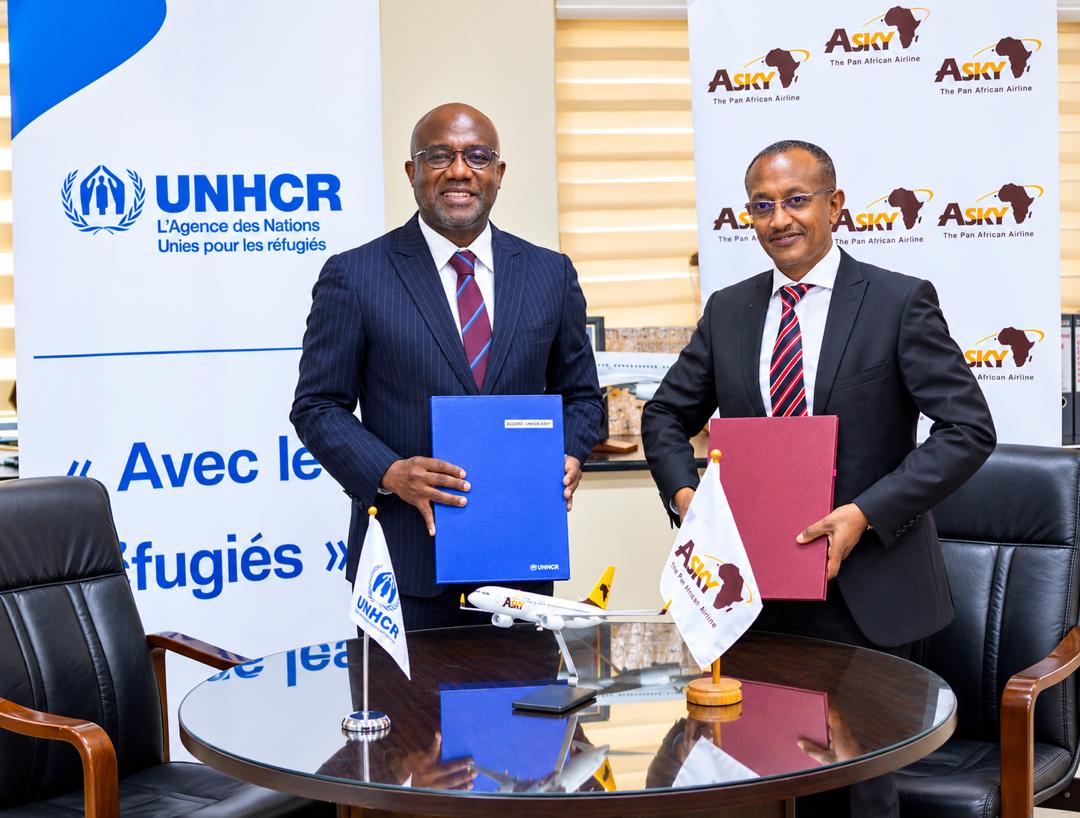
The United Nations High Commissioner for Refugees (UNHCR) and pan-African airline Compagnie Aérienne ASKY have launched a three-year partnership to create new pathways into employment, skills development and entrepreneurship for refugees across West and Central Africa.
The agreement, which initially covers Senegal, Ghana, Benin, Togo, Nigeria and Côte d’Ivoire, is designed to move refugee support beyond humanitarian assistance by connecting displaced people with jobs, vocational training, business opportunities and private-sector markets.
The initiative will initially concentrate on technical and vocational training, scholarships, internships and employment pathways within the aviation industry. It could subsequently be expanded to include refugee entrepreneurship, access to supply chains and opportunities in agricultural value chains.
The partnership comes as countries across West and Central Africa continue to deal with a large and complex displacement crisis. UNHCR said that, as of September 2026, more than four million refugees and asylum-seekers were living across the region.
Women and children account for about 80 per cent of that population, while almost 751,000 people have been identified as having specific protection needs, including women and children at risk and people living with disabilities.
For the two organisations, providing access to work and economic opportunities is an important component of addressing the longer-term consequences of displacement.
UNHCR Regional Director for West and Central Africa, Abdouraouf Gnon Konde, said prolonged displacement required approaches that enabled refugees to regain independence and rebuild their lives.
“When displacement lasts for years, access to skills, markets and decent work is essential to restoring choice and dignity,” Konde said.
He said UNHCR was seeking to help half of refugees living in protracted situations across the region move away from long-term dependence on humanitarian assistance towards self-reliance and sustainable solutions by 2035.
“Our ambition is to help half of refugees in protracted situations across the region move from long-term aid dependency towards self-reliance and lasting solutions by 2035,” he said.
According to him, collaboration with African businesses such as ASKY could turn that objective into practical opportunities for refugees, particularly women and young people, while also strengthening the economies and communities hosting them.
The aviation industry will provide the initial entry point for the partnership, with ASKY agreeing to consider qualified refugees for its existing training programmes, internships and recruitment opportunities.
Participation will, however, remain subject to available openings and the airline’s normal qualification and recruitment requirements.
The partnership will also examine opportunities for refugee-owned businesses to become part of ASKY’s supply chain.
This could create opportunities beyond conventional employment by enabling refugee entrepreneurs to provide goods and services to businesses and access markets outside their immediate communities.
Lomé, the Togolese capital and home of ASKY, is also being considered as a potential training hub for the programme.
Through the airline’s regional network, the partners intend to connect refugees with employment and skills opportunities across different labour markets rather than limiting support to traditional refugee assistance locations.
Particular emphasis will be placed on refugee women and girls, who often encounter additional barriers to education, vocational training and access to decent work.
The programme is expected to explore aviation-related education, mentorship and professional development opportunities for women and girls, as well as supplier opportunities for refugee-led artisan enterprises.
ASKY Chief Executive Officer, Esayas W. Hailu, said the airline considered refugee inclusion part of its broader role in Africa’s economic development.
“As a pan-African airline, we see a direct link between our business and Africa’s development,” Hailu said. “Refugees are part of the communities we serve. Through this partnership, we want to connect their talent and enterprise with opportunities in aviation and encourage other African companies to integrate refugee inclusion into the way they do business.”
The agreement is expected to extend beyond training and recruitment. Following the signing, UNHCR and ASKY will establish arrangements covering training, scholarships, internships and employment, while also considering humanitarian transport where appropriate.
The initial discussions include the possibility of using Lomé as a training centre and expanding livelihoods and employment opportunities in Ghana.
In Senegal, the partners will explore ways of connecting refugee-owned businesses with markets, while in Côte d’Ivoire they will examine opportunities to support family reunification and voluntary return movements.
The inclusion of business and supply-chain opportunities is particularly significant because it gives the initiative an economic dimension beyond conventional refugee assistance.
UNHCR said linking refugee skills and enterprises with private-sector demand could benefit both displaced people and businesses by providing refugees with routes towards self-reliance while giving companies access to talent, goods and services.
The initiative is also expected to demonstrate how African companies can play a greater role in refugee inclusion and sustainable development.
The partnership gives ASKY an opportunity to leverage its regional network in support of UNHCR’s efforts across West and Central Africa.
The airline currently serves 30 cities in 28 African countries with a fleet of 17 aircraft. Its operations are supported through a strategic and technical partnership with Ethiopian Airlines.
ASKY’s shareholders include regional financial institutions such as the ECOWAS Bank for Investment and Development (EBID), West African Development Bank (BOAD) and Ecobank Group, alongside Ethiopian Airlines and the Government of Togo.
The airline has positioned intra-African connectivity, tourism and economic development as central elements of its business model.
For UNHCR, the agreement represents its first partnership with a regional airline in West and Central Africa and what the agency describes as the first initiative of its kind in sub-Saharan Africa.
UNHCR’s Regional Bureau for West and Central Africa, based in Dakar, Senegal, coordinates operations in 23 countries, including across the Sahel, Lake Chad Basin and Gulf of Guinea.
The agency works with governments, host communities and other partners to protect displaced people, strengthen asylum systems and pursue durable solutions for people affected by conflict, insecurity, climate shocks and socio-economic pressures.
With millions of refugees and asylum-seekers across the region, UNHCR and ASKY see private-sector engagement as an important component of efforts to ensure that displacement does not permanently exclude people from education, employment and economic participation.
The three-year partnership is consequently expected to serve as a test of how aviation and other African businesses can help turn refugee inclusion from a humanitarian objective into practical opportunities for skills acquisition, employment, entrepreneurship and participation in regional economies.