
Shareholders Applaud Fidelity Bank’s N532.6bn Capital Base, Earnings Growth
Shareholders of Fidelity Bank Plc have commended the Board and Management of the bank for strengthening its capital base, improving asset quality and sustaining earnings growth despite prevailing economic challenges.
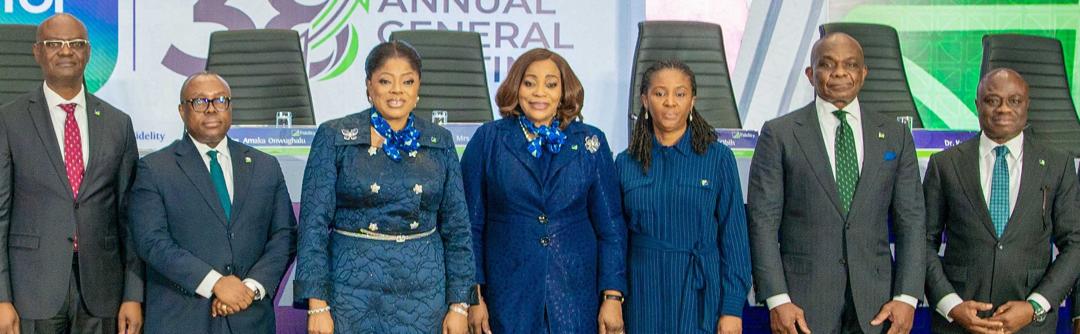
The commendation came at the bank’s 38th Annual General Meeting (AGM), held virtually on Friday, 9 October 2026, where shareholders reviewed the financial institution’s performance for the year ended 31 December 2025 and expressed confidence in its strategic direction.
The shareholders highlighted the bank’s improved risk management indicators, successful capital-raising exercise and strong financial performance as evidence of its capacity to remain resilient and deliver sustainable returns to investors.
Speaking at the meeting, Bisi Bakare, National Coordinator of the Pragmatic Shareholders Association of Nigeria, described the bank’s non-performing loan (NPL) ratio of 2.4 per cent and capital adequacy ratio of approximately 16.1 per cent as positive indicators of its financial strength.
Bakare also noted that the bank’s growing customer base demonstrated its capacity to expand its operations and strengthen its position in Nigeria’s competitive banking industry.
“The figures demonstrate that the bank remains strong. With a non-performing loan ratio of 2.4 per cent, a customer base of 16 million and a capital adequacy ratio of 16.1 per cent, shareholders have reasons to support the Board and Management,” he said.
Another shareholder, Boniface Okezie, Chairman of the Progressive Shareholders Association, commended the bank’s leadership for successfully completing its capital-raising exercise, which positioned it above the Central Bank of Nigeria’s minimum capital requirement for banks with international authorisation.
According to Okezie, the exercise would strengthen the bank’s financial position and improve its capacity to support customers, pursue growth opportunities and create long-term value for shareholders.
“We commend the Board and Management for the successful capital-raising exercise. This gives us greater confidence in the future of the bank and its capacity to deliver sustainable value to shareholders,” he said.
Fidelity Bank completed a N227.05 billion private placement in December 2025, increasing its eligible capital from N305.5 billion to N532.6 billion.
The transaction raised the bank’s capital above the N500 billion minimum requirement for banks operating with international authorisation, strengthening its capacity to meet regulatory expectations and support its business expansion plans.
The successful capital raise also featured prominently in the bank’s efforts to reinforce its balance sheet and maintain financial stability amid regulatory changes and a challenging operating environment.
Earnings rise by 45.6%
Presenting the bank’s performance, the Board Chairman, Mrs Amaka Onwughalu, said the institution remained committed to building a stronger, more agile and sustainable organisation capable of delivering long-term value to shareholders and other stakeholders.
She said the bank’s strategy was anchored on trust, innovation, responsible growth and the creation of lasting value, adding that its leadership was focused on building an institution capable of adapting to changes in the financial services industry.
“At Fidelity Bank, we are building for the long term by creating lasting value through trust, innovation and shared progress. Guided by purpose and responsibility, we are building a stronger, more agile and more sustainable institution, one designed to thrive through change and deliver enduring impact for generations,” Onwughalu said.
The bank’s audited financial statements for 2025 showed that gross earnings increased by 45.6 per cent to N1.52 trillion, compared with N1.04 trillion recorded in 2024.
Profit before tax stood at N347.7 billion, while profit after tax closed at N242.4 billion, reflecting the bank’s earnings performance during the financial year.
The growth in gross earnings represented an increase of N480 billion over the preceding year, highlighting the expansion in the bank’s income base.
Beyond its earnings, Fidelity Bank reported improvements in several key asset quality and risk management indicators, which shareholders identified as important measures of its financial resilience.
The bank’s non-performing loan ratio declined to 2.4 per cent from 3.1 per cent, indicating an improvement in the proportion of its loan portfolio classified as non-performing.
Its loan-loss coverage ratio also increased to 203.9 per cent from 138.4 per cent, suggesting a stronger provision buffer against potential losses from non-performing loans.
The bank’s liquidity ratio stood at 66.5 per cent, significantly above the regulatory minimum of 30 per cent. The position indicated that the bank maintained liquidity well above the prescribed threshold.
Total equity also increased to N1.09 trillion from N897.9 billion, further strengthening its capital position.
The combination of improved asset quality, higher loan-loss coverage, strong liquidity and increased equity provided the basis for shareholders’ commendation of the bank’s management.
The Managing Director and Chief Executive Officer of Fidelity Bank, Dr Nneka Onyeali-Ikpe, said the bank would continue to focus on building a resilient institution, deepening customer relationships and delivering sustainable value to shareholders and other stakeholders.
She stressed that improving access to financial services remained central to the bank’s strategy, alongside efforts to strengthen its operations and provide services that meet customers’ changing needs.
“Our focus remains on making financial services easy and accessible to our customers while building a stronger institution for shareholders, employees and the communities we serve,” Onyeali-Ikpe said.
Her remarks underscored the bank’s stated commitment to balancing business expansion and profitability with customer service and stakeholder interests.
The bank’s financial statements also received an unmodified audit opinion from its external auditors, Deloitte & Touche.
The auditors stated that the consolidated and separate financial statements fairly presented the bank’s financial position, financial performance and cash flows in accordance with applicable financial reporting standards and Nigerian laws.
An unmodified opinion indicates that the auditors did not consider it necessary to qualify their opinion on the financial statements.
At the AGM, shareholders received and considered the audited financial statements and the reports of the Directors, External Auditors, Statutory Audit Committee and Independent Board Appraisal Consultants for the financial year ended 31 December 2025.
Shareholders consider board changes
In addition to reviewing the bank’s financial performance, shareholders considered several corporate governance and administrative matters.
These included the election of Dr Jonathan Ososuakpor as a Non-Executive Director and the re-election of Onwughalu as a Non-Executive Director.
The meeting also noted the retirement by rotation of Chief Nelson Nweke as a Non-Executive Director.
Shareholders further considered the authorisation of the Directors to determine the remuneration of the external auditors for the 2026 financial year.
Other matters included the disclosure of the remuneration of the bank’s managers and the election of members of the Statutory Audit Committee.
The decisions formed part of the bank’s annual governance processes, which provide shareholders with an opportunity to review its performance, consider board composition and address matters relating to accountability and oversight.
Following the presentation of the financial results and consideration of the meeting’s business, shareholders urged the Board and Management to sustain the bank’s performance, strengthen its competitiveness and improve returns to investors.
They also called for continued attention to prudent risk management, business growth and strategies capable of protecting shareholder value amid changing market conditions.
Expanding customer reach
Fidelity Bank Plc is a commercial deposit money bank serving customers through its digital banking platforms and physical business offices in Nigeria, alongside its United Kingdom subsidiary, FidBank UK Limited.
The bank operates a network of 255 business offices in Nigeria and has continued to use digital channels to expand access to its services.
The company has also received several local and international awards in recognition of its activities in retail banking, small and medium-sized enterprise financing, trade finance, innovation and community development.
Among its recognitions are the 2025 Development Bank of Nigeria Innovation Award for MSME support and the Best Retail and SME Bank Award presented by Independent Newspapers.
It also received the Best Bank for Export and Trade Finance and Most Innovative Bank of the Year awards at the 2025 BusinessDay Banks and Financial Institutions Awards.
Other recognitions include Nigeria’s Best Private Bank at the 2025 Euromoney Awards, the inaugural Most Improved Commercial Bank of the Year award from Nairametrics, and the SME Bank of the Year award from NewsDirect.
The bank also received the Straight-Through Processing Excellence Award from Citi Group and recognition from Global Brands Magazine for Excellence in Community Empowerment.
With its strengthened capital base, improved asset quality and increased earnings, Fidelity Bank faces the task of sustaining its growth trajectory while maintaining prudent lending standards, deepening customer relationships and delivering competitive returns to shareholders.