
NDLEA Canine Handlers Get Specialised Training From German Experts
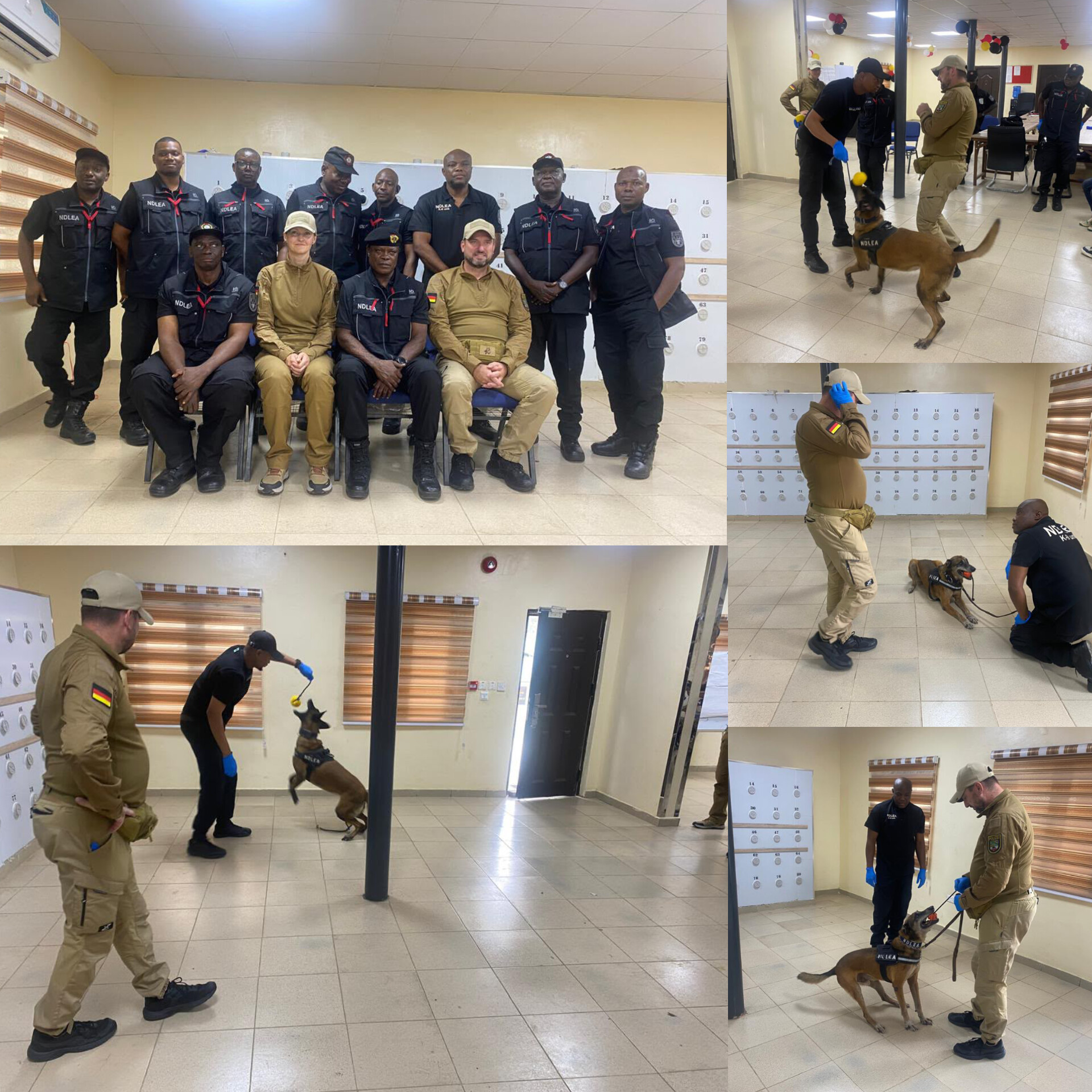
The National Drug Law Enforcement Agency (NDLEA) has strengthened the capacity of its canine unit with specialised refresher training for dog handlers conducted by German technical experts as part of efforts to improve the detection and interception of illicit drugs.
The training, held at the NDLEA Canine Unit Facility in Lagos, was organised in collaboration with the German Bundeskriminalamt (BKA), Germany’s federal criminal police office.
The exercise was facilitated by two German technical dog-handling experts, Andreas Roscher and Jacqueline Shüler, who provided the Nigerian handlers with practical training based on international best practices in canine deployment for narcotics detection.
A total of 11 personnel from the NDLEA Canine Unit participated in the programme. They comprised the unit commander, two veterinary doctors and eight dog handlers, alongside their service dogs.
Five other NDLEA officers from commands within Lagos who had expressed interest in joining the Canine Unit also participated in the training.
The programme focused on strengthening both the technical and operational capabilities of the handlers and their dogs.
Areas covered included advanced obedience and control, narcotics detection techniques, scent imprinting and search patterns.
The participants also underwent real-life simulation exercises designed to replicate the conditions under which canine teams are deployed to detect concealed narcotics.
The practical sessions were conducted at key transportation and cargo facilities in Lagos, including the baggage hall of the Murtala Muhammed International Airport (MMIA), APM Terminals Apapa and the MMIA NAHCO export shed.
The handlers were also trained on safety and tactical considerations for deploying canine assets in high-risk operational environments.
The NDLEA Chairman/Chief Executive Officer, Brig. Gen. Mohamed Buba Marwa (rtd), said the exercise demonstrated the agency’s commitment to developing a highly skilled and professional workforce capable of responding to increasingly sophisticated methods employed by drug trafficking organisations.
Marwa described the agency’s canine teams as among its most important assets in detecting and intercepting illicit drugs, particularly at airports, seaports and border crossings.
“Our canine teams remain one of the most potent assets in our detection and interdiction efforts, and this is why we will continue to invest in their retraining and welfare,” he said.
According to him, the interceptions of concealed narcotics recorded at the country’s airports, seaports and border points had been supported significantly by the capabilities of the dogs and the handlers responsible for deploying them.
“The successes we have recorded at our airports, seaports and border points in intercepting concealed narcotics are in no small measure due to the dedication and sharpened instincts of our dogs and their handlers,” Marwa added.
He said the collaboration with the German authorities would further strengthen the agency’s operational capacity while helping its canine teams align their methods with international standards.
The NDLEA boss, however, acknowledged that the agency’s Canine Unit still faced manpower and logistics challenges that could limit its ability to provide comprehensive coverage across the country’s major entry and exit points.
He identified the need for additional service dogs, more trained personnel and improved boarding facilities as some of the areas requiring attention.
According to him, these resources are necessary to adequately cover Nigeria’s seaports, international airports and land borders, where canine teams play an important role in the detection of drugs concealed in luggage, cargo and other consignments.
Marwa said the agency was already working towards addressing the identified gaps. He also disclosed that the refresher training would be sustained as an annual exercise, following recommendations arising from the programme.
The decision is expected to provide regular opportunities for handlers and their dogs to update their skills, improve coordination and adapt to emerging techniques used in narcotics concealment and trafficking.
The latest training also underscores the growing emphasis by the NDLEA on specialised operational capabilities as drug trafficking networks increasingly employ sophisticated methods to move illicit substances through Nigeria’s transportation and logistics corridors.
With Nigeria serving as a major regional aviation and maritime hub, the agency’s canine teams are deployed at strategic points where passengers, baggage, cargo and other consignments are screened for prohibited substances.
The NDLEA said continued investment in training, equipment, personnel and the welfare of service dogs would remain important to sustaining the effectiveness of the Canine Unit in the agency’s wider fight against illicit drug trafficking.